


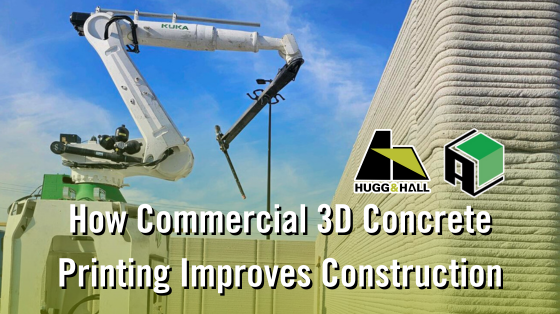
How Commercial 3D Concrete Printing Improves Construction
Hugg & Hall Equipment and Alquist collab to bring 3D concrete printing to the commercial world.
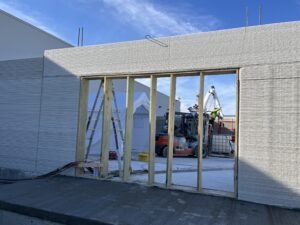
A Hugg & Hall forklift used to lift materials in Lamar, MO.
What’s happening
It’s some of the biggest news to hit the industry in years: 3D concrete printing (3DCP) has positioned itself as a viable option in the commercial sphere. And it’s not just a distant possibility: it’s happening right now.
Employees from Hugg & Hall Equipment, Alquist, and FMGI just wrapped up an exciting project in Lamar, MO: adding a 5,000 square foot addition to a rural Walmart store.
This is the third Walmart addition from Alquist and FMGI, with at least a dozen more expected.
These additions go up incredibly fast, they’re able to withstand the elements far better than traditional construction, and they save their builders money.
Want to see how it works? Keep reading for a video of the process!
And the best part? It’s not self-contained. There are human hands touching every step of the process, from design to setup to printing. And it’s going to revolutionize the way we work.
The major players
Alquist
The creators. Alquist is one of the only 3DCP companies in the US that does it all: they created the technology, construct and maintain the robots, design the buildings in a 3D design software, and are on-site to handle issues during printing.
Many of Alquist’s team members have backgrounds in other fields, ranging from affordable housing initiatives to Counter IED Operations.

Zachary Mannheimer
When you’re on an Alquist jobsite, you’ll see employees from many companies working to keep things running smoothly. That’s not a flaw, or a bug to be worked out in future iterations. Zachary Mannheimer, founder of Alquist, says, “This is the future of construction on every jobsite: technology complementing humans.”
Hugg & Hall Equipment Co
A nationally recognized equipment services provider, based in Little Rock and operating in Arkansas, Louisiana, Oklahoma, Texas, and Missouri. Hugg & Hall is an equipment dealer for several major brands and offers rentals, service, parts, and more.
Hugg & Hall provided the construction equipment for the Lamar job and will be the exclusive equipment provider for any future Alquist/Walmart jobs.
In 2025, Hugg & Hall purchased a robot kit from Alquist and plans to offer 3DCP rentals in the near future.
FMGI
A preferred contractor for Walmart, based on a 15-year working relationship. Superintendent Nick Pulley and his team have been onsite since the first Alquist/Walmart collab and help keep these jobsites running.
Walmart
The first company to adopt 3DCP on a large scale. While adding space to existing stores for pickup orders and online order fulfillment, Walmart saw an opportunity to enter a new world of construction while simultaneously saving money and time.

Nick Pulley
Nick Pulley with FMGI said admiringly, “Walmart thinks 10 years ahead of everyone else. This is just the latest time they’ve done that.” He admits he was skeptical of Alquist’s lofty promises at first, but that witnessing their process changed his mind.
That first [Walmart] job in Athens was a success because it taught us so much. We could have done five ‘standard’ jobs and not learned what we did. I watched this tech provide our customer with a lot of value, and it was so much faster than anything else. —Nick Pulley
Sika Concrete
The concrete provider for Alquist and FMGI’s projects. Sika is a national company with more than 100 years of experience.
Their work with Alquist represents a major success: a more environmentally friendly concrete that holds its shape when printing and has greater PSI strength when cured.
Sika offers Alquist an exclusive price on materials due to job volume, which helps Alquist offer lower prices for their clients. Noah Callantine, Process Engineer & Field Service Specialist at Sika, told us, “Alquist proved that they offer a unique value, for their customers and for us. For them, there’s a price that matches that value.”
In an article with CNBC, Noah said, “This collaboration positions Sika at the forefront of next-generation construction, opening new markets and creating long-term growth opportunities.” Courtesy of CNBC.
Aims Community College
One of the first educational institutions providing 3D concrete printing training for students.
As 3DCP is so new—and yet, so poised to take over the market—there’s a massive education gap. Aims Community College is looking to close that margin.
With training in 3D design software, batch mixing, robotics, and more, Aims leads the way for other 3DCP education programs across the world.
Aims is located in Greeley, Colorado (which is also home to Alquist).

Kat Seale
Each of these players offer something unique to the world of commercial 3D concrete printing, and all are necessary. What’s more, the employees are just as important. Kat Seale, Technical Project Manager for Alquist, told us, “This is a team sport. None of this would be possible without all of these companies—and each of these employees—working together to make it happen.”
How commercial 3D concrete printing works
The printer
If you’ve ever seen a tabletop 3D printer, you get the gist.
Each 3DCP jobsite has at least two robotic arms, a mixing plant, and a hose connecting the two. Every additional robotic arm allows the job to move faster, as one can print while another is being set up.
The materials
Unlike standard concrete, which needs forms to hold it in place, this concrete is stable enough to hold its shape right out of the nozzle when stacked on top of itself.
The concrete pumped from the nozzles is a reduced-carbon mixture that is better for the planet than traditional building materials. It is stronger than traditional concrete when dry.
The employees
Just like any delicate process in construction, the 3DCP robots are constantly monitored by a team of experts. This team checks for issues with the nozzles and hoses, as well as any problems with the print. If something should go wrong, they can remove a whole level of printed concrete before it sets.
On an Alquist jobsite, you’ll also find other equipment and operators. Hugg & Hall, which supplies all the equipment for the Alquist/Walmart collaboration, provided scissor lifts, a forklift, a telehandler, light towers, generators, and more for the Lamar project.
Hugg & Hall also sent a Shop Service Technician, Luke Fess, to work on the 3D concrete printer and any equipment as needed. With any new technology, you can expect a few bugs, but a skilled technician can keep any jobsite moving.
Hugg & Hall’s Rick Vollmer (VP of Growth and Strategy) said the following about 3DCP machines and the connection to the more traditional rental ecosystem:
It sounds out-of-this-world that there’s synergy between, say, a forklift—which has been around for 100 years—and this project, but it has similar requirements. It still needs a technician that understands the mechanical, technical, and hydraulic abilities of the equipment. It needs a driver to get it from Point A to Point B. And it needs a customer base—even as the industry shifts, it’s going to be a lot of the same customer base we do business with today. —Rick Vollmer

Who benefits
It’s easy to say that 3DCP benefits everyone. But it does benefit companies, employees, and employers alike.
The companies
The most obvious beneficiaries of reduced-cost building. With reduced labor costs and lower material costs thanks to Sika, Alquist saves their clients hundreds of thousands of dollars on building (and millions of dollars over the course of multiple projects).
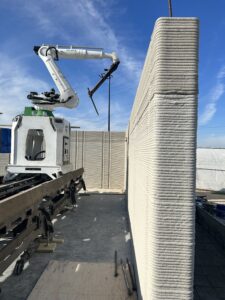
An Alquist 3D concrete printer.
The employees & employers
3DCP will revolutionize the way employees work, and it’ll also benefit their employers during a time that threatens labor shortages. Mason Walker of Walker Masonry believes the benefits to workers and their employers are intertwined:
In a time of uncertain labor and workforce availability, this is a viable option to maintain the efficiency, cost, and scheduling of a project. Ultimately, from a consumer perspective, it’s about days-to-completion; from a workforce perspective, it’s about how many backs can we save?
We’ve seen several journeymen over the years barely able to move when it’s time to retire. This kind of tech will help compensate for most of the heavy lifting these guys would have had to do in the past. For instance, a block mason would have been carrying 180–270-pound blocks a day.
There’s going to be a learning curve, but the younger generation will be more prepared for the system interfacing and technological components, and the older tradesmen can bring in their wealth of knowledge about the materials being used and the methods of construction. They’ll help bridge the generational gap.
—Mason Walker
The community at large
One of the biggest benefits to the rise of commercial 3DCP? It’ll increase demand across the board, including for residential 3DCP projects.
And 3DCP isn’t just a cool new way to build your house (though it is that): it’s also a way for many affordable housing initiatives to meet their goals and build homes for the unhoused.
John Hugg, President of Hugg & Hall and an outspoken proponent of affordable housing, said:
This technology offers us all a higher quality of construction. On cost and labor savings alone, it creates a lot of opportunity—it’s a change agent in the construction industry. It offers a lot of potential improvements for people. And I’m really excited to see what it can do for housing and making people’s lives better.
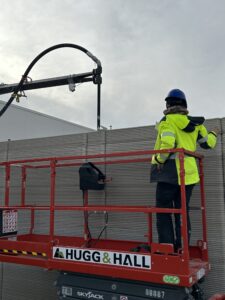
Kat Seale, Technical Project Manager with Alquist, watches a 3D concrete printer from a Hugg & Hall scissor lift.
In summary: why commercial 3D concrete printing?
Infinitely faster and more efficient: Exact numbers are still incoming, but Forbes estimates residential 3DCP may be up to 50% faster than traditional building. Alquist boasts they’re already building at 5x the speed of a normal commercial addition—and they’re only getting started.
Safer for all involved: It’s not as hard on human bodies, there’s fewer risks associated with working at height, and it involves less dangerous machinery.
Less waste = better for the planet: The same Forbes article estimated that 3DCP will produce 99% less waste than traditional building. In a world where we’ll increasingly need to meet new environmental regulations, it’s a big leap.
A chance to bring in a younger workforce: With programs like Aims Community College’s new 3DCP training (and other colleges following suit), there’s an untapped workforce that can help revitalize the construction industry.
Human workers play a vital part: Despite the increased mechanization involved in 3DCP, according to Kat Seale, “There’s always the human hand. And that’s the case here. But it’s infinitely more accurate, with another level of accountability: less wasted materials and less wasted time.”

Patrick Callahan
It’s the way of the future: Patrick Callahan, CEO of Alquist, said it best: “Adoption is hard, but we’re here to enable, not to replace. These are tools for employees to use, and they provide labor that has been restricting the industry.”
Back to News
Subscribe and unlock cutting-edge equipment insights, trends and tips!
Subscribe